
Gabriela
Tabacaru
Abstract:- about the journal
- editors
- reviewers
- call for papers
- address











 ▲
▲

p-ISSN: 2068 - 0473
e-ISSN: 2067 - 3957
10.18662/brain
DOI prefix: 10.70594/brain (currently edited by EduSoft) | 10.18662/brain (when was edited by Lumen)
4 issues/year (occasional additional issues)
Web of Science (ESCI, IF 0.6), EBSCO, Google Scholar etc.
Member in CrossRef
CURRENT ISSUE 
LAST 2 PREVIOUS ISSUE
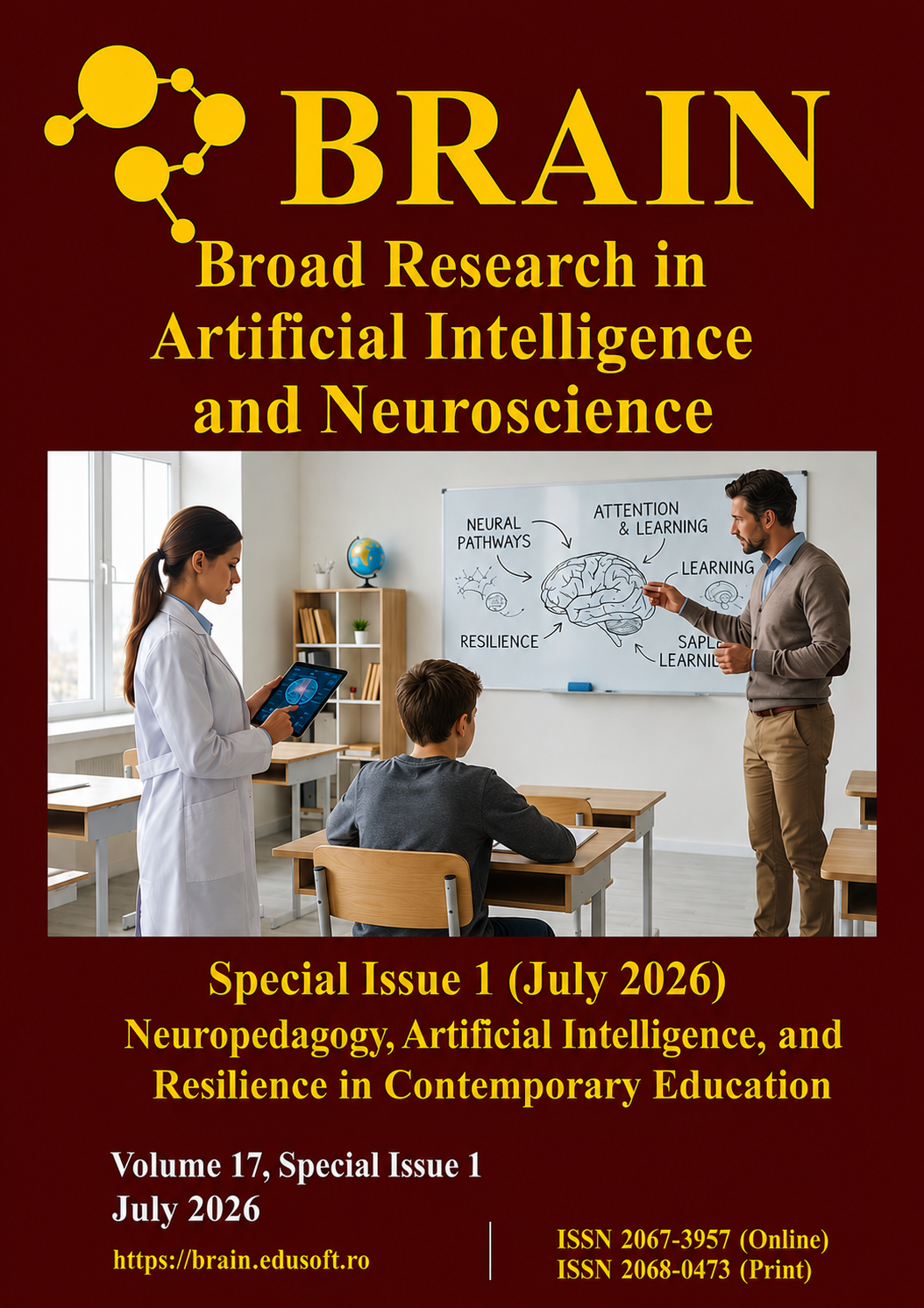



Disclaimer: These images were generated using artificial intelligence and may contain inaccuracies or inconsistencies. They are provided solely as a visual aid to facilitate the rapid understanding of the key ideas presented in these article. Our editorial team conducts ongoing reviews of AI-generated images and will correct or replace them whenever an error or discrepancy is identified or reported.
- about the journal
- editors
- reviewers
- call for papers
- address

Disclaimer: This image was generated using artificial intelligence and may contain inaccuracies or inconsistencies. It is provided solely as a visual aid to facilitate the rapid understanding of the key ideas presented in this article. Our editorial team conducts ongoing reviews of AI-generated images and will correct or replace them whenever an error or discrepancy is identified or reported.
Authors:Fingerprint identification is an important field in the wide domain of biometrics with many applications, in different areas such: judicial, mobile phones, access systems, airports. There are many elaborated algorithms for fingerprint identification, but none of them can guarantee that the results of identification are always 100 % accurate. A first step in a fingerprint image analysing process consists in the pre-processing or filtering. If the result after this step is not by a good quality the upcoming identification process can fail. A major difficulty can appear in case of fingerprint identification if the images that should be identified from a fingerprint image database are noisy with different type of noise. The objectives of the paper are: the successful completion of the noisy digital image filtering, a novel more robust algorithm of identifying the best filtering algorithm and the classification and ranking of the images. The choice about the best filtered images of a set of 9 algorithms is made with a dual method of fuzzy and aggregation model. We are proposing through this paper a set of 9 filters with different novelty designed for processing the digital images using the following methods: quartiles, medians, average, thresholds and histogram equalization, applied all over the image or locally on small areas. Finally the statistics reveal the classification and ranking of the best algorithms.

Disclaimer: This image was generated using artificial intelligence and may contain inaccuracies or inconsistencies. It is provided solely as a visual aid to facilitate the rapid understanding of the key ideas presented in this article. Our editorial team conducts ongoing reviews of AI-generated images and will correct or replace them whenever an error or discrepancy is identified or reported.
Authors:This paper describes some biologically-inspired processes that could be used to build the sort of networks that we associate with the human brain. New to this paper, a "˜refined' neuron will be proposed. This is a group of neurons that by joining together can produce a more analogue system, but with the same level of control and reliability that a binary neuron would have. With this new structure, it will be possible to think of an essentially binary system in terms of a more variable set of values. The paper also shows how recent research can be combined with established theories, to produce a more complete picture.
The propositions are largely in line with conventional thinking, but possibly with one or two more radical suggestions. An earlier cognitive model can be filled in with more specific details, based on the new research results, where the components appear to fit together almost seamlessly. The intention of the research has been to describe plausible "˜mechanical' processes that can produce the appropriate brain structures and mechanisms, but that could be used without the magical "˜intelligence' part that is still not fully understood.
There are also some important updates from an earlier version of this paper.
Keywords: neuron, neural network, cognitive model, self-organise, analogue, resonance.

Disclaimer: This image was generated using artificial intelligence and may contain inaccuracies or inconsistencies. It is provided solely as a visual aid to facilitate the rapid understanding of the key ideas presented in this article. Our editorial team conducts ongoing reviews of AI-generated images and will correct or replace them whenever an error or discrepancy is identified or reported.
Authors:Semantic data browsing is important task for open and governmental data in behalf of public control. There are many projects and solutions regarding semantic data browsing and navigation, but despite the fact, in Slovakia, the availability of such data is poor. It is a shame, because projects like National Action Plan of Open Government and the site data.gov.sk are already operating for several years. In this work we would like to point out key aspects of semantic data and detail the Slovak market of semantic data. We design and propose our solution of semantic data browsing, evaluate the implementation in our AGECRT NET tool.

Disclaimer: This image was generated using artificial intelligence and may contain inaccuracies or inconsistencies. It is provided solely as a visual aid to facilitate the rapid understanding of the key ideas presented in this article. Our editorial team conducts ongoing reviews of AI-generated images and will correct or replace them whenever an error or discrepancy is identified or reported.
Authors:Department of Computer Science and Engineering,
Anna University Regional Centre, Coimbatore, India
m.sribtechit@gmail.com
J. Preethi
Department of Computer Science and Engineering
Anna University Regional Centre, Coimbatore, India
preethi17j@yahoo.com
Emotions are very important in human decision handling, interaction and cognitive process. In this paper describes that recognize the human emotions from DEAP EEG dataset with different kind of methods. Audio — video based stimuli is used to extract the emotions. EEG signal is divided into different bands using discrete wavelet transformation with db8 wavelet function for further process. Statistical and energy based features are extracted from the bands, based on the features emotions are classified with feed forward neural network with weight optimized algorithm like PSO. Before that the particular band has to be selected based on the training performance of neural networks and then the emotions are classified. In this experimental result describes that the gamma and alpha bands are provides the accurate classification result with average classification rate of 90.3% of using NNRBF, 90.325% of using PNN, 96.3% of using PSO trained NN, 98.1 of using Cuckoo trained NN. At last the emotions are classified into two different groups like valence and arousal. Based on that identifies the person normal and abnormal behavioral using classified emotion.

Disclaimer: This image was generated using artificial intelligence and may contain inaccuracies or inconsistencies. It is provided solely as a visual aid to facilitate the rapid understanding of the key ideas presented in this article. Our editorial team conducts ongoing reviews of AI-generated images and will correct or replace them whenever an error or discrepancy is identified or reported.
Authors:The purpose of this study is to estimate what we know about Generation Y students' behavior in Social Media (SM), especially in our country. The correct identification of their traits is crucial for the academic community, primarily from the perspective of understanding their real needs, as beneficiaries of teaching act, followed by a serious and consistent adaptation of our offer. In an extended literature review, we try to determine the reasons for SM use, their preferences for one medium or another, the way, place and time of SM use, and the Romanian particularities in the general personality portrait observed and explained by literature. We discuss the advantages and
disadvantages of their intensive SM use, show how the time spent in SM affect the individuals and the universities, and try to find out what their needs and expectancies are. In our opinion, the problems treated here are of interest both for professors as individuals, and for the universities' and faculties' management — especially in a world in which the borderline between the physical and virtual life is becoming more and more difficult to draw.

Disclaimer: This image was generated using artificial intelligence and may contain inaccuracies or inconsistencies. It is provided solely as a visual aid to facilitate the rapid understanding of the key ideas presented in this article. Our editorial team conducts ongoing reviews of AI-generated images and will correct or replace them whenever an error or discrepancy is identified or reported.
Authors:Internet and social media (SM) have revolutionized the way scientific information is disseminated within our society. Nowadays professional and/or social networks are increasingly used for learning and informal science education successfully supplements the formal one at all
educational levels. Students become addicted to technology from an early age and consistently use SM for communication purposes and personal image. In this context, it is reasonable to assume that the use of Web 2.0 and SM can be successfully integrated in formal science education. This integration, however, depends mainly on how teachers design the learning activities using Web 2.0 and SM, on their digital skills and expertise, on their attitude towards using SM to communicate for personal and professional purposes and to obtain educational benefits. In this study we start from the premise that a positive attitude of future science teachers towards ICT integration and their
willingness to use SM in their educational communication can be formed in the initial teacher training program, being a crucial factor for the effective use of such tools in education in the future. We detail two activities and analyze them from the SM and Web 2.0 integration perspectives. The first activity is an extracurricular one in which students had to create a digital story and present it to secondary school children in class. The second activity is a curricular one aimed to promote a project-based learning and based on making a comic about an optical phenomenon taught in secondary school. We present and discuss these activities to emphasize how the skills that target
science teaching using ICT and SM can be developed.