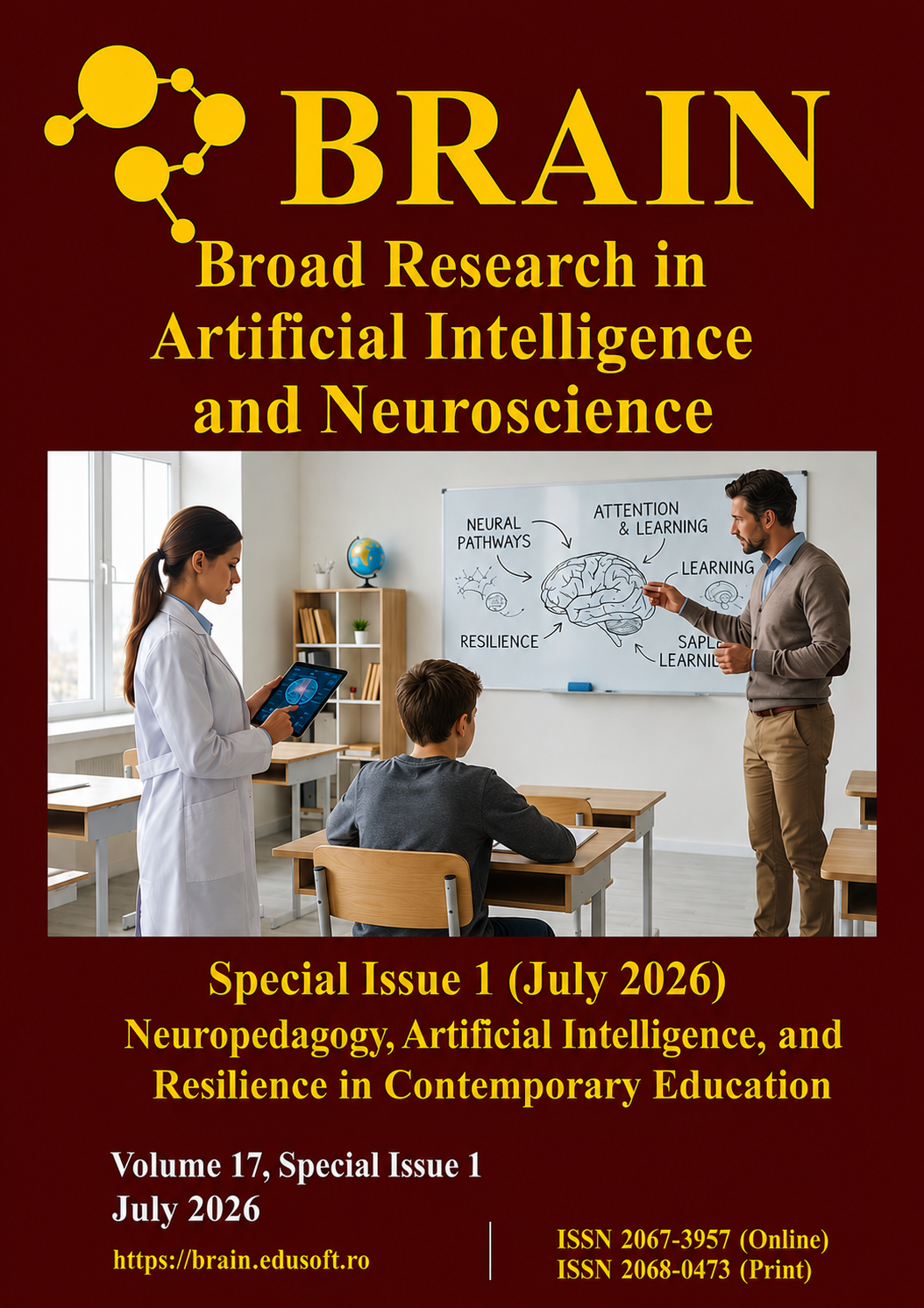
Disclaimer: These images were generated using artificial intelligence and may contain inaccuracies or inconsistencies.
They are provided solely as a visual aid to facilitate the rapid understanding of the key ideas presented
in these article. Our editorial team conducts ongoing reviews of AI-generated images and will correct
or replace them whenever an error or discrepancy is identified or reported.
Disclaimer: This image was generated using artificial intelligence and may contain inaccuracies or inconsistencies.
It is provided solely as a visual aid to facilitate the rapid understanding of the key ideas presented
in this article. Our editorial team conducts ongoing reviews of AI-generated images and will correct
or replace them whenever an error or discrepancy is identified or reported.
Authors:
Nabil
M. Hewahi
Abstract:
In this paper we propose a general approach based on Genetic Algorithms (GAs) to evolve Hidden Markov Models (HMM). The problem appears when experts assign probability values for HMM, they use only some limited inputs. The assigned probability values might not be accurate to serve in other cases related to the same domain. We introduce an approach based on GAs to find
out the suitable probability values for the HMM to be mostly correct in more cases than what have been used to assign the probability values.
Disclaimer: This image was generated using artificial intelligence and may contain inaccuracies or inconsistencies.
It is provided solely as a visual aid to facilitate the rapid understanding of the key ideas presented
in this article. Our editorial team conducts ongoing reviews of AI-generated images and will correct
or replace them whenever an error or discrepancy is identified or reported.
Authors:
Nitin Balaji
Bilgi
, R. V.
Kulkarni
Abstract:
The basic aim of this research, described in this paper is to develop a hybrid legal expert system/ knowledge based system, with specific reference to the transfer of property act, within the Indian legal system which is often in demand. In this paper the authors discuss an traditional approach to combining two types of reasoning methodologies, Rule Based Reasoning (RBR) and Case Based Reasoning (CBR). In RBR module we have interpreted and implemented rules that occur in legal statutes of the Transfer of property act. In the CBR module we have an implementation to find the related cases. The VisiRule software made available by Logic Programming Associates is used in the development of RBR part this expert system. The authors have used java Net Beans for development of CBR. VisiRule is a decision charting tool, in which the rules are defined by a combination of graphical shapes and pieces of text, and produces rules.
Disclaimer: This image was generated using artificial intelligence and may contain inaccuracies or inconsistencies.
It is provided solely as a visual aid to facilitate the rapid understanding of the key ideas presented
in this article. Our editorial team conducts ongoing reviews of AI-generated images and will correct
or replace them whenever an error or discrepancy is identified or reported.
Authors:
Parvaneh
Khosravizadeh
, Samira
Mollaei
Abstract:
This study is an attempt to explore the difference between acquiring new words with different semantic fields to which they belong. In other words, the purpose of this study is to scrutinize the contribution of semantic field theory in learning new vocabulary items in an EFL setting. Thirty-eight students of three different levels of education took part in this research. They were exposed to some new words from four different semantic fields, and then they were tested on their acquisition of the words meaning. This exposure was through reading texts and the aim of reading was just comprehension, therefore the words were acquired incidentally. The outcome showed significant differences between groups with different levels of education regarding retention of words from different semantic fields.
Disclaimer: This image was generated using artificial intelligence and may contain inaccuracies or inconsistencies.
It is provided solely as a visual aid to facilitate the rapid understanding of the key ideas presented
in this article. Our editorial team conducts ongoing reviews of AI-generated images and will correct
or replace them whenever an error or discrepancy is identified or reported.
Authors:
Sara
Atef-Vahid
, Alireza
Fard Kashani
Abstract:
The present study explored English language learning anxiety among 38 third-year high school students in English classrooms and its relationship with overall English achievement. Students’ foreign language anxiety was surveyed and analyzed using the Foreign Language Classroom Anxiety Scale (Horwitz, Horwitz, & Cope, 1986) [14] and their English achievement was measured through their final standardized English exam administered by the school. The results showed that although some students felt extremely confident and relaxed, however, one-third of the
students experienced moderate to high-anxiety levels while learning the English language in class. Correlational analysis revealed that the total FLCAS scores had a significantly moderate negative correlation (r=-.0586, p<.01) with the total final English exams scores of the participants. Anxiety was also analyzed according to the four different variables of anxiety (communication anxiety, test anxiety, fear of negative evaluation, English classroom anxiety) which were measured by the FLCAS. The results of the Pearson correlational analysis indicated that English achievement was modestly correlated with all four anxiety variables (p<0.01). Of the four types of anxiety, English Classroom anxiety had the highest correlational value. Finally, possible anxiety provoking factors
leading to these findings are examined and discussed, and some pedagogical implications are proposed.
Disclaimer: This image was generated using artificial intelligence and may contain inaccuracies or inconsistencies.
It is provided solely as a visual aid to facilitate the rapid understanding of the key ideas presented
in this article. Our editorial team conducts ongoing reviews of AI-generated images and will correct
or replace them whenever an error or discrepancy is identified or reported.
Authors:
Farid
Ghaemi
, Laleh
Fakhraee Faruji
Abstract:
In language acquisition, ‘Emergentists’ claim that simple learning mechanisms, of the kind attested elsewhere in cognition, are sufficient to bring about the emergence of complex language
representations (Gregg, 2003). Connectionist model is one of the models among others proposed by emergentists. This paper attempts to clarify the basic assumptions of this model, its advantages, and the criticisms leveled at it.











 ▲
▲